CONNELLWA.COM Staff
May 5, 2026
CONNELL, WA -
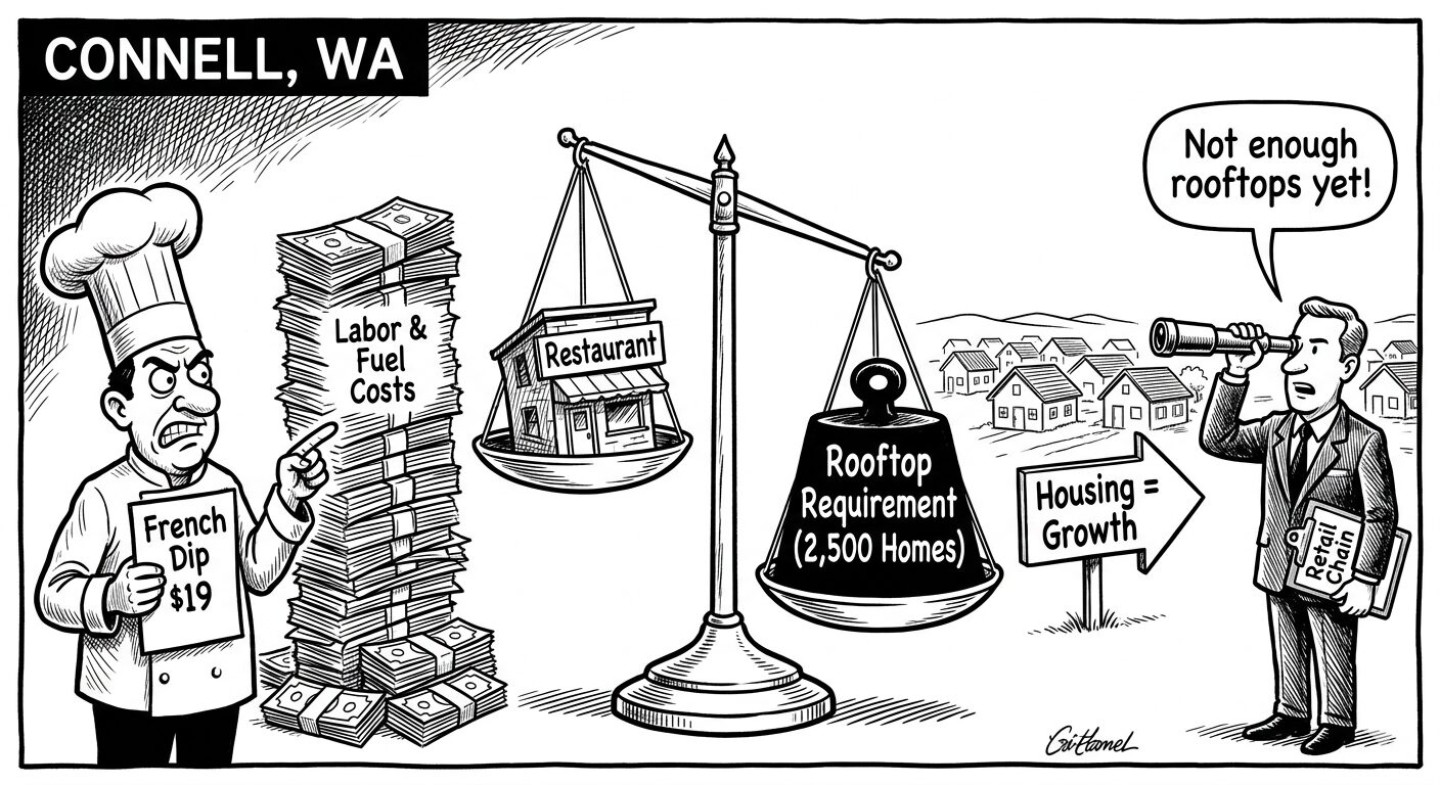
The reality of the hospitality industry in Washington state is dictated by a rigid set of economic formulas that often clash with community desires. From skyrocketing labor costs to the "rooftop rule" of commercial real estate, the barrier to entry for new businesses in Franklin County has never been higher. Why doesn’t Connell have more sit-down restaurants, cafés, or recognizable chains?
Economic forces, not lack of interest, are shaping what gets built—and what doesn’t.
The Math Behind the Menu: Why a French Dip Costs $19
The "mom and pop" restaurant model is famously grueling. Industry veterans often joke that opening a family business is less like starting a career and more like "gaining another spouse"—one that demands 80 hours a week and offers no guarantee of a paycheck.
In Washington state, the cost of doing business is heavily influenced by two primary factors: labor and logistics.
- The Wage Gap: In the late 1990s, Washington state’s minimum wage ranged from $5.70 to $6.50 per hour. As of January 1, 2026, that figure has climbed to $17.13 per hour. For a small operation in Connell with three employees working 40 hours a week, monthly wage expenditures alone amount to approximately $11,000 before taxes and insurance.
- The Fuel Factor: As of July 2025, Washington state’s gas tax increased to 55.4 cents per gallon, with additional costs from the state’s cap-and-trade program adding nearly 60 cents more per gallon. These costs are directly reflected in the "delivery surcharges" on every crate of food trucked into town.
To maintain a viable business, restaurants typically aim for a 300% to 400% markup on raw food costs. When labor and fuel costs rise, the end product must follow suit. This economic trajectory explains why a French Dip sandwich that cost $9 a decade ago now frequently clears the $19 mark on modern menus.
The "Rooftop Rule": Why Big Brands Pass on Small Towns
A common frustration in regional development is the perceived snubbing of growing areas by major retailers. A prime example is the long-standing push for a Barnes & Noble in the Southridge area of Kennewick. Despite intense local lobbying, developers often rely on "rooftop counts" rather than community enthusiasm.
The Rooftop Formula
Retail giants like Costco and Barnes & Noble typically require a specific density of residential "rooftops" within a three-to-five-mile radius before considering a new build.
- Threshold: Most major retailers look for a minimum of 2,500 to 5,000 homes in the immediate vicinity.
- The Southridge Lesson: While Southridge is a premier growth area, its position on the edge of the Tri-Cities meant its "circle" on the map included a significant amount of undeveloped land, failing to meet the density requirements that a central location (like the Columbia Center area) provides.
For Connell, the "magic number" for new commercial interest is estimated to be approximately 200 additional homes. Projects like the Oasis Village expansion (Oasis 2) were designed to bridge this gap, though current estimates suggest that even these developments may only provide about 50 of the 100 originally projected units. Following a stakeholder's bankruptcy, the Oasis 2 property was put up for auction in mid-2026.
The Dilution Dilemma
A common misconception is that more options lead to a better economy. However, in a town of roughly 2,000 residents (not homes), the "available spend" is a finite pie.
| Establishment Type | Typical Monthly Sales Needed | Population Needed to Support |
|---|---|---|
| Full-Service Restaurant | $30,000 - $50,000 | 1,000 "Regulars" |
| Coffee Shop / Taco Truck | $10,000 - $15,000 | 300 - 500 "Regulars" |
A Call for New Factions
The social fabric of Connell is currently in a state of transition. The "long-timers" who have historically sat on city councils and planning commissions are beginning to age out.
For first-generation residents and newcomers, this era represents a unique opportunity to reshape the town. Rather than waiting for a "tycoon" to swoop in, local leaders argue that the future of Connell lies in housing, not just hot wings. By prioritizing residential growth and supporting existing local staples—like the town’s two distinct pizza offerings—the community can finally build the density required to attract the "desired" businesses they crave.
Summary of Key Findings
- Labor and Logistics: Small businesses in Washington face a steep climb due to a minimum wage that has risen from under $7.00 in the 90s to $17.13 in 2026. Additionally, fuel taxes and state programs add over $1.00 per gallon in total impact, raising the cost of every crate of food delivered.
- The "Rooftop" Barrier: Large chains like Costco or Barnes & Noble do not prioritize community interest alone; they require high residential density (rooftops) within a 3-to-5-mile radius.
- The Growth Solution: Local leaders suggest that Connell's future relies on housing, not just hot wings. Achieving residential projects like the Oasis Village expansion is critical to building the density required for new commercial interest.
- Generational Opportunity: As long-time civic leaders age out, there is a unique opening for newcomers to take the reins of city planning and reshape Connell's economic fabric.
Bibliography & Read More
- Washington State Department of Labor & Industries: History of Washington State’s Minimum Wage
- King 5 News: Barnes & Noble Expansion Plans for 2026
- Affordable Fuel Washington: The Impact of Washington State Gas Taxes on Consumers
- Lexi Witt Real Estate: Connell Development Opportunities and Oasis Village
- National Restaurant Association: 2026 Financial Benchmarks and Profit Margins