-CONNELLWA.COM Staff
January 15, 2026
Key Takeaways
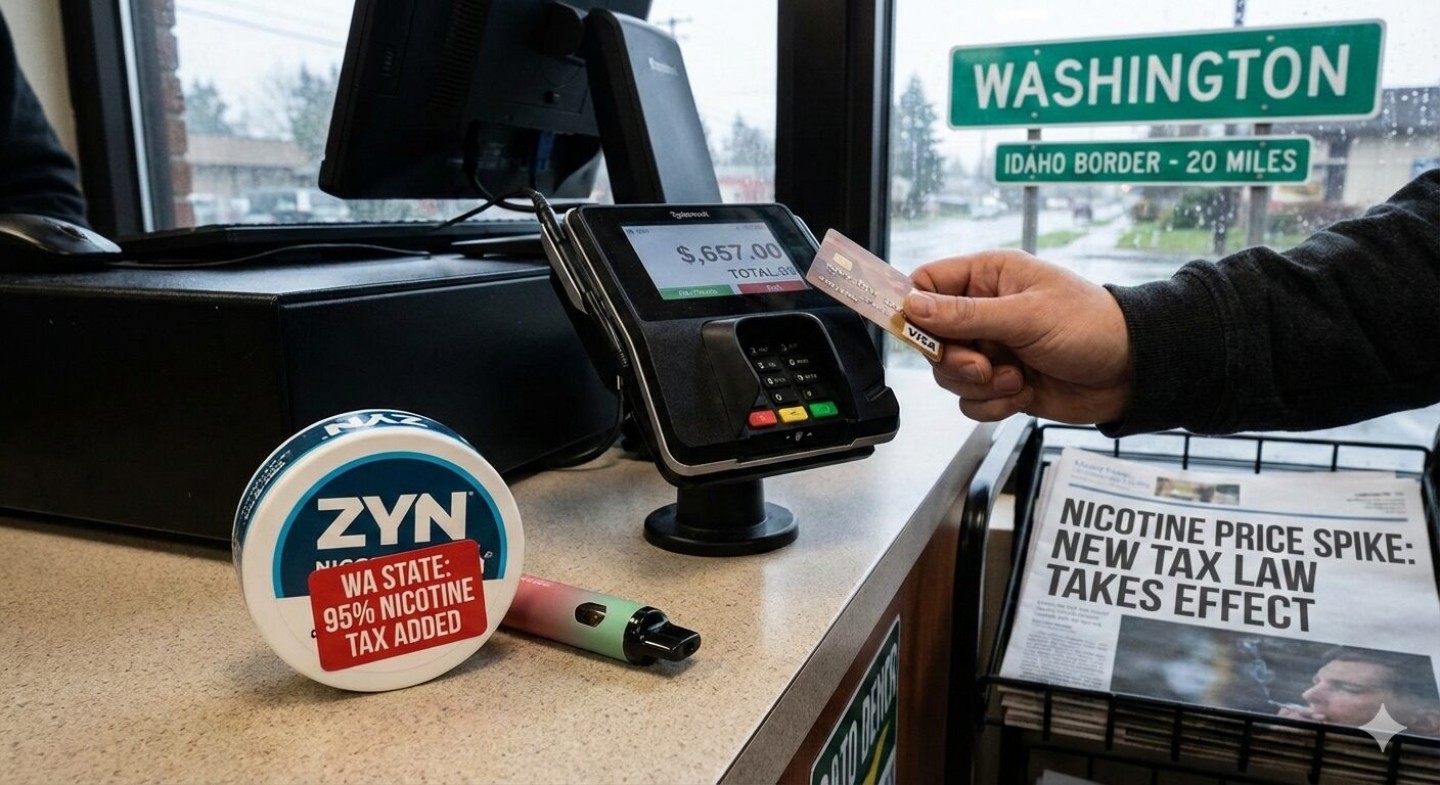
- The Price Jump: A 5-can roll of nicotine pouches has surged from $30 to nearly $60 in Washington.
- The Science: Emerging research suggests isolated nicotine may have neuroprotective benefits for Parkinson's and Alzheimer's.
- The Legal War: Lawsuits from retailers and corporations like Comcast are challenging the procedural validity of the new tax.
- The Vote: The tax passed by a razor-thin 50–47 margin in the House, highlighting deep political division.
The Washington Nicotine Tax at a Glance
- The Change: As of January 1, 2026, Washington state has expanded its 95% excise tax to include all nicotine products, including synthetic pouches (like Zyn) and vapes.
- The Impact: Prices have effectively doubled. A $30 roll of pouches now costs nearly $60, driving many residents to buy in bulk across the Idaho border.
- The Conflict: While the FDA recognizes these products as a less harmful alternative for smokers, Washington state treats them with the same financial deterrence as combustible tobacco.
- The Science: Experts argue that while nicotine is addictive, it is not the primary cause of cancer—that comes from tobacco smoke. Some research even suggests isolated nicotine has neuroprotective benefits.
- The Legal War: Retailers are currently suing the state, arguing that the Department of Revenue is "unlawfully rewriting" the law to tax vapes twice.
| Newly Taxed (95%) | Exempt / No Change |
| Zyn / Nicotine Pouches (Synthetic) | Traditional Cigarettes (Fixed per-pack tax) |
| Disposable Vapes (e.g., ElfBar, Breeze) | FDA-Approved Cessation (Patches, Gum) |
| Nicotine E-Liquids (All strengths) | 0% Nicotine Juice (Stays at volume tax) |
| Synthetic Nicotine (Any form) | Prescription Cessation (Chantix/Varenicline) |
Washington State — January 15, 2026 — For years, nicotine has been the undisputed villain of public health. But as of the new year, a massive tax hike in Washington state has turned a scientific debate into a pocketbook crisis, forcing a confrontation between two very different views of the molecule: is it a deadly toxin or a tool for survival?
Under the newly enacted Engrossed Substitute Senate Bill 5814, Washington now applies a 95% excise tax to all products containing nicotine—including synthetic nicotine pouches like Zyn. The move has effectively doubled the price of these products overnight, sending a wave of "tax refugees" across the border to Idaho.
The Legislative Breakdown
Senate Bill 5814 was a centerpiece of the 2025 legislative session’s budget package, aimed at closing a projected multibillion-dollar shortfall. The bill passed both chambers by narrow margins, primarily along party lines, though it faced notable internal opposition from some members of the majority party.
Executive Action: Governor Bob Ferguson signed the bill into law on May 20, 2025, with the nicotine tax provisions officially taking effect on January 1, 2026.
Senate Vote (April 24, 2025): Passed 26–22. Despite the Democratic majority, three Democrats joined all 19 Republicans in voting "no," citing concerns over the regressive nature of the sales tax expansion.
House Vote (April 23, 2025): Passed 50–47. In the House, seven Democrats broke ranks to vote against the measure, nearly defeating the bill.
Those in favor of the nicotine tax are all Democrats
| Chamber | Yeas | Nays | Result |
| Washington State Senate | 26 | 22 | Passed (April 24, 2025) |
| Washington State House | 50 | 47 | Passed (April 23, 2025) |
For consumers like Jeff Long, who spoke to 4 News Now in Spokane, the math is simple. A five-can roll of nicotine pouches that cost $30.00 last year now retails for nearly $60.00. "Basically, you're going to end up paying double," Long said. "So you either pay it or you drive to Idaho."
The Science: Is Nicotine the Problem?
The core of the "Nicotine Paradox" lies in a distinction often lost in public policy: the difference between the molecule itself and the smoke that carries it.
Public health experts like Dr. Peter Attia and neuroscientist Dr. Andrew Huberman have increasingly pointed out that while nicotine is highly addictive, it is not a primary carcinogen. The cancer and lung disease associated with smoking are largely caused by the combustion of tobacco leaf, which releases thousands of toxic chemicals like formaldehyde and heavy metals.
The Brain’s Accelerator and Brake
In the brain, nicotine acts as a powerful stimulant by hijacking the reward system. Huberman describes the process as a "two-pronged attack" on the dopamine system: nicotine triggers a surge of dopamine (the "accelerator") while simultaneously suppressing GABA (the "brake"), the neurotransmitter that usually regulates those surges.
This results in sharpened focus, reduced appetite, and increased metabolic rate. Research from 2024 also suggests nicotine may have neuroprotective properties, potentially slowing the progression of Parkinson’s disease and counteracting genetic risks for Alzheimer’s.
The Mendelian Counter-Proof
A landmark 2024 Mendelian randomization study—a type of research that uses genetic markers to isolate behavior—provided further evidence for this theory. By comparing people with different genetic predispositions for nicotine metabolism, researchers found that the devastating diseases linked to smoking were strongly tied to the heaviness of smoking (how much tobacco was burned) rather than the nicotine levels themselves.
The Counter-Narrative: Why the Tax Exists
Despite the harm-reduction arguments, critics of the "isolated nicotine" theory argue that "safer" does not mean "safe."
1. The Youth Epidemic
Health organizations point to alarming trends. A 2024 USC study revealed that nicotine pouch use among American teens doubled in a single year. Critics argue that "Zynfluencer" culture on social media targets a new generation that never would have touched a cigarette, hooking them on high-dose nicotine that can disrupt developing brains.
2. Cardiovascular Strain
While nicotine may not cause cancer directly, it remains a potent vasoconstrictor. Constant use keeps the heart rate elevated and blood vessels constricted, which can lead to long-term hypertension and increased heart attack risk.
Legal Battles: The 95% Tax Under Fire
Since its enactment, SB 5814 has become one of the most litigated tax measures in recent Washington history. As of early 2026, the law faces two primary legal challenges:
1. The "Vape Tax Interpretation" Petitions
Two petitions have been filed against the Washington Department of Revenue (DOR). These challenges focus on the DOR's decision to apply the 95% tax to vapor products.
- The Argument: Petitioners argue the DOR is "unlawfully rewriting the law." They contend that vapor products are already governed by a separate tax (RCW 82.25) which SB 5814 did not explicitly repeal.
- The Claim: Lawsuits allege the tax violates the Washington Constitution's "single-subject rule," as the bill's title did not clearly disclose a massive increase in vapor taxes.
2. The Comcast Challenge
A major lawsuit filed by Comcast challenges the same bill (SB 5814) regarding its taxation of digital advertising. Legal analysts suggest that if the court finds the advertising portion of the bill unconstitutional, the procedural validity of the entire bill—including the nicotine tax—could be in jeopardy.
A Regulatory Split
The conflict is perfectly captured by the differing stances of the state and federal governments. In 2025, the FDA authorized the sale of several nicotine pouch brands, concluding they were "appropriate for the protection of public health" as a less harmful alternative for adult smokers. Washington state, however, has chosen a path of broad deterrence, treating these pouches with the same—and in some cases higher—financial weight as the cigarettes they were meant to replace.
Frequently Asked Questions (FAQ)
Does this tax apply to Zyn pouches?
Yes. This was the primary target of SB 5814. Previously, synthetic nicotine pouches occupied a "tax loophole" in Washington. They are now classified as "Other Tobacco Products" (OTP) and subject to the full 95% rate.
Why are my vape pods suddenly $10 more expensive?
The Department of Revenue has interpreted the new law to include any product containing nicotine. Because the tax is based on the price (ad valorem) rather than the amount of liquid, high-value disposables and pod systems have seen the most dramatic price hikes.
Is there a legal challenge to stop this?
Yes. In late December 2025, two major petitions were filed in Thurston County Superior Court. The plaintiffs argue that the legislature only intended to tax nicotine pouches, and the DOR "unilaterally" expanded the tax to vapes without a new vote. An emergency stay hearing is currently pending; if granted, the tax on vapes could be paused while the case proceeds.
Are "nicotine-free" vapes affected?
Generally, no. If a product contains 0mg nicotine, it should still be taxed under the old volume-based vapor tax (RCW 82.25) rather than the new 95% nicotine tax. However, some retailers are struggling with the math and may have raised prices across the board.
Sources
- Washington State Legislature: Final Vote Tallies for ESSB 5814 (2025)
- Washington Department of Revenue: Special Notice: Nicotine Products Subject to Tobacco Tax (Nov 2025)
- PLOS Genetics: Mendelian randomization study on nicotine vs. tobacco constituents (2024)
- KIRO 7 News / 4 News Now: [Local coverage of the 2026 tax implementation and "Idaho Effect."]
- Tobacco Harm Reduction 101 (THR101): [Summary of Legal Petitions against WA Dept of Revenue.]